

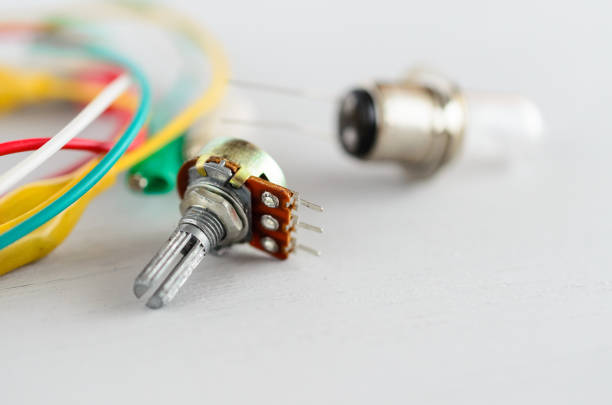
When engineers and purchasing teams select a 10K potentiometer, they often wonder whether 5KΩ, 50KΩ, or another resistance value would work better for their circuit. For many audio controls, gaming interfaces, and household appliances, 10KΩ is a practical default because it provides a useful balance between loading, power consumption, noise sensitivity, and circuit compatibility. However, the best potentiometer resistance depends on the actual circuit design rather than the application name alone.
For manufacturers requiring a specific resistance value, custom potentiometer resistance is also available. Values can be specified according to the electrical requirements of the circuit, while resistance markings or codes such as B100 can identify the required nominal value depending on the supplier’s coding system.
What Does Potentiometer Resistance Mean?
A potentiometer is a three-terminal variable resistor commonly used to adjust voltage, signal level, position, or other electrical parameters.
Its resistance value describes the total resistance between the two outer terminals.
Common values include:
- 1KΩ
- 5KΩ
- 10KΩ
- 20KΩ
- 50KΩ
- 100KΩ
- 500KΩ
- 1MΩ
The selected value affects how the potentiometer interacts with the surrounding circuit.
Resistance Is Not the Same as Output Range
One important point is often misunderstood.
When a potentiometer operates as a voltage divider, the ideal output voltage ratio is primarily determined by the wiper position and the applied input voltage.
The resistance value itself does not automatically determine the percentage of output voltage.
For example, an ideal 10KΩ potentiometer and a 50KΩ potentiometer can both provide the same 0–100% voltage adjustment range when connected in the same voltage-divider configuration.
The difference appears in how much current flows and how the potentiometer loads the circuit.
10K vs 5K vs 50K: The Basic Comparison
The three resistance values represent different trade-offs.
| Resistance | Current at Same Voltage | Power at Same Voltage | Noise Sensitivity | Typical Consideration |
|---|---|---|---|---|
| 5KΩ | Higher | Higher | Lower | Stronger loading, lower impedance |
| 10KΩ | Moderate | Moderate | Moderate | Practical general-purpose choice |
| 50KΩ | Lower | Lower | Higher | Higher impedance, lower circuit loading |
The table assumes the same applied voltage and comparable operating conditions.
The key relationship is:
Power = V² ÷ R
Therefore, when voltage remains constant, increasing resistance reduces the power dissipated by the resistive element.
This makes resistance selection an electrical design decision rather than simply a matter of choosing the most common value.
Why 10KΩ Is a Common Default Choice
A 10K potentiometer often works well as a middle-ground solution.
It is neither particularly low resistance nor particularly high resistance.
This can provide a practical balance between:
- Circuit loading
- Current consumption
- Noise sensitivity
- Signal integrity
- Availability
- Component compatibility
For this reason, 10KΩ is frequently considered when engineers need a general-purpose potentiometer for control or voltage-divider applications.
However, 10KΩ should be treated as a safe starting point, not a universal rule.
The circuit’s input impedance, required current, noise environment, and control function should determine the final value.
When Should You Choose a 5K Potentiometer?
A 5K potentiometer provides lower resistance than a 10KΩ component.
At the same applied voltage, the lower resistance allows more current to flow.
Advantages of 5KΩ
A lower resistance can be useful when the circuit benefits from:
- Lower source impedance
- Reduced susceptibility to some forms of external interference
- Stronger loading capability
- Faster settling in certain circuits
It can also be appropriate when the following circuit stage has relatively low input impedance.
The Trade-Off: Higher Current
The main disadvantage is increased current consumption.
For a resistive load connected directly across a voltage source:
I = V ÷ R
Reducing resistance from 10KΩ to 5KΩ approximately doubles the current under the same voltage.
Therefore, engineers should not automatically replace a 10K potentiometer with a 5K version without checking the circuit’s power budget.
When Should You Choose a 50K Potentiometer?
A 50K potentiometer provides substantially higher resistance than a 10KΩ.
Its main advantage is lower current consumption when used across the same voltage source.
Lower Resistance Loading
A higher resistance can reduce the load placed on the driving circuit.
This can be useful when the circuit needs to minimize current draw or when the signal source cannot comfortably drive a lower resistance.
The Trade-Off: Higher Impedance
The disadvantage is that higher resistance can make the circuit more sensitive to unwanted interference and noise pickup.
The surrounding circuit also becomes more important.
For example, long PCB traces, cables, high-impedance inputs, and electrically noisy environments may make a high-value potentiometer less attractive.
Therefore, 50KΩ is not automatically better simply because it consumes less current.
How Resistance Affects Audio Potentiometers
Audio equipment is one of the most common applications for potentiometers.
They can control:
- Volume
- Tone
- Balance
- Gain
- Mixing levels


Why 10KΩ Can Work Well in Audio Circuits
For some audio control circuits, 10KΩ provides a practical balance between signal loading and noise performance.
However, audio applications require additional consideration beyond resistance.
Check the Circuit’s Input and Output Impedance
The potentiometer does not operate in isolation.
Its resistance interacts with the impedance of the source and the input stage.
If the potentiometer resistance is too low, it may load the previous circuit.
If it is too high, the circuit may become more susceptible to noise and other parasitic effects.
Resistance Value Is Only One Specification
Audio buyers should also evaluate:
- Taper
- Number of channels
- Shaft type
- Rotation angle
- Power rating
- Contact resistance
- Mechanical life
- Tolerance
For volume controls, audio/logarithmic taper may also be more appropriate than a simple linear taper because human hearing responds approximately logarithmically to sound pressure.
How Resistance Affects Gaming Controllers
Potentiometers can also serve as position sensors in gaming equipment.
Applications may include:
- Steering wheels
- Joysticks
- Pedal controls
- Throttle controls
- Position sensing mechanisms

Why 10KΩ Is Often Practical for Position Sensing
A 10K potentiometer can provide a useful voltage-divider output for an analog position input.
The controller reads the wiper voltage and converts the voltage into a position value.
In an ideal voltage-divider configuration, changing the resistance from 10KΩ to 50KΩ does not change the theoretical voltage percentage at a particular wiper position.
However, the connected ADC or input circuit has finite impedance.
That means the actual output can change because of loading effects.
Match the Potentiometer to the ADC Input
When selecting a potentiometer for gaming equipment, engineers should check:
- ADC input impedance
- Sampling speed
- Required resolution
- Noise level
- Cable length
- Supply voltage
- Mechanical rotation angle
- Expected operating life
Therefore, 10KΩ is a useful default for many analog position-sensing applications, but the ADC and signal-conditioning circuit should make the final decision.
How Resistance Selection Works in Home Appliances
Potentiometers also appear in household and commercial appliances.
Potential applications include:
- Fan speed controls
- Temperature adjustment
- Lighting controls
- Appliance user interfaces
- Motor control interfaces
- Audio controls

5KΩ for Lower Impedance Applications
A 5K potentiometer may be suitable when the circuit requires relatively low impedance and can accommodate higher current.
10KΩ for General Control Circuits
10KΩ can be a convenient choice for general-purpose analog adjustment and voltage-divider applications.
50KΩ for Lower Current Applications
50KΩ may be appropriate when reducing current consumption and circuit loading is more important than minimizing impedance.
The correct selection ultimately depends on the appliance’s electrical architecture.
How Resistance Changes Power Consumption
Power consumption is one of the clearest differences between resistance values.
Consider a simple example using a 5V supply.
For a 5KΩ potentiometer:
P = 5² ÷ 5,000 = 5 mW
For a 10KΩ potentiometer:
P = 5² ÷ 10,000 = 2.5 mW
For a 50KΩ potentiometer:
P = 5² ÷ 50,000 = 0.5 mW
Therefore:
5KΩ → highest power
10KΩ → moderate power
50KΩ → lowest power
This relationship is particularly relevant for battery-powered equipment where every component contributes to overall energy consumption.
Does Higher Resistance Always Mean More Noise?
Not necessarily, but higher resistance can increase susceptibility to noise.
A higher-value potentiometer presents a higher impedance to the surrounding circuit.
That can make the circuit more sensitive to:
- Electromagnetic interference
- Long signal paths
- PCB parasitic effects
- Input leakage
- Environmental electrical noise
At the same time, the actual noise performance depends on the complete circuit.
Therefore, engineers should evaluate the potentiometer together with the signal source, input stage, PCB layout, cables, shielding, and filtering.
How to Select the Right Potentiometer Resistance
Instead of asking “Which resistance is best?”, engineers should ask:
“Which resistance best matches my circuit?”
A practical selection process includes five steps.
Step 1: Check the Supply Voltage
Determine the voltage applied across the potentiometer.
This establishes the basic current and power relationship.
Step 2: Calculate Current and Power
Use:
I = V ÷ R
and
P = V² ÷ R
Compare the expected power with the potentiometer’s rated power.
Step 3: Check the Load Impedance
The following circuit can affect the actual voltage-divider output.
A high-value potentiometer may interact differently with a low-impedance input than a 10KΩ component.
Step 4: Evaluate Noise Requirements
If the circuit operates in a noisy environment or handles low-level signals, resistance and impedance deserve particular attention.
Step 5: Confirm Mechanical Requirements
Electrical resistance is only part of the specification.
Also confirm:
- Shaft diameter
- Shaft length
- Mounting style
- Rotation angle
- Detents
- Switch function
- Terminal configuration
- Mechanical life
- Operating torque
10K Is a Safe Default, But Not a Universal Answer
The comparison between 5K, 10K, and 50K potentiometers shows why resistance selection should follow electrical requirements rather than popularity.
5KΩ can be useful when lower impedance is important, but it draws more current.
10KΩ provides a practical middle ground and is often a strong default for general-purpose control and voltage-divider applications.
50KΩ reduces current consumption and circuit loading, but its higher impedance may increase sensitivity to noise and loading effects from the following circuit.
For most procurement teams, the practical rule is:
Use 10KΩ as the default starting point unless the circuit design requires another resistance value.
Then verify the choice against power consumption, input impedance, noise requirements, and mechanical specifications.
For OEM and bulk buyers, working with a supplier capable of custom potentiometer resistance can provide greater flexibility when the standard 10KΩ value does not fit the circuit.
FAQ About Potentiometer Resistance
Is 10KΩ the best potentiometer resistance?
Not universally. 10KΩ is a practical default for many control and voltage-divider circuits, but the correct value depends on circuit impedance, power consumption, noise requirements, and application.
What is the difference between a 5K and 10K potentiometer?
At the same voltage, a 5KΩ potentiometer draws approximately twice the current of a 10KΩ potentiometer. It also presents lower impedance to the surrounding circuit.
Why would I use a 50K potentiometer?
A 50KΩ potentiometer can reduce current consumption and circuit loading. However, its higher impedance may make the circuit more sensitive to noise and input leakage.
Does potentiometer resistance change the voltage range?
In an ideal voltage-divider circuit, changing the total resistance does not change the theoretical voltage ratio at a given wiper position. The connected load can affect the actual output.
Is a 10K potentiometer suitable for audio equipment?
It can be suitable for many audio control circuits, but engineers should also consider taper, source impedance, input impedance, noise, power rating, and channel configuration.
Is 10KΩ suitable for gaming steering wheels?
A 10K potentiometer can work well for many analog position-sensing designs. The final selection should consider the ADC input impedance, signal conditioning, mechanical requirements, and expected service life.
Can I order a custom potentiometer resistance?
Yes. Manufacturers and suppliers may offer custom resistance values based on the electrical and mechanical requirements of the application.
What does B100 mean on a potentiometer?
In commonly used coding conventions, B100 often indicates a 100KΩ linear potentiometer. Because coding standards can vary, buyers should verify the exact meaning with the supplier datasheet.
Should I always choose 10KΩ for a potentiometer?
No. 10KΩ is a good default starting point, not a universal requirement. Check the circuit’s load impedance, current, power, noise, and mechanical requirements before finalizing the resistance.


