

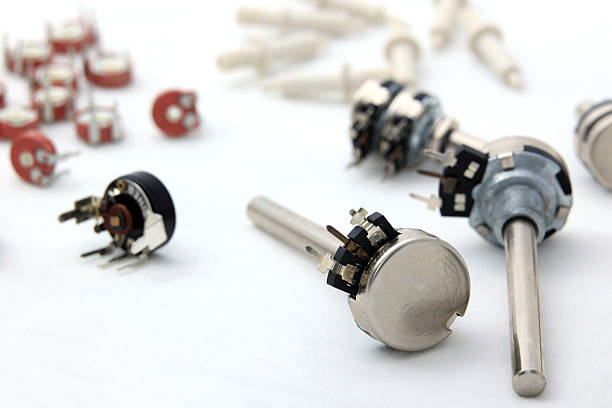
In electronic design, 10KΩ is the most frequent value on any circuit board. Engineers often reach for this specific specification without a second thought. However, this choice rests on deep physical principles and balancing acts. Choosing 10kΩ potentiometers provides a perfect compromise between power, noise, and signal integrity. This guide explains why this value dominates the world of analog and digital electronics. We help you understand the “golden middle” for your next precision project.
1. The Power vs. Heat Equation
Circuit efficiency depends on managing how much energy turns into wasted heat.
Managing Low Power Consumption
The formula $P = U^2 / R$ dictates the power dissipated by a component. Consequently, a very low resistance like 100Ω, draws excessive current from the supply. This drains batteries quickly and generates unwanted heat in small enclosures. Furthermore, 10kΩ keeps the current draw in the microampere range for 5V systems. Therefore, 10kΩ potentiometers are ideal for modern, energy-efficient mobile devices.
2. The Battle Against Thermal Noise
Every resistor generates a tiny amount of “hiss” known as Johnson-Nyquist noise.
Why Not Use Megohms?
You might think higher resistance is always better for power saving. However, thermal noise is proportional to the square root of the resistance ($\sqrt{R}$). Consequently, a 1MΩ potentiometer creates significantly more background noise than a 10kΩ version. Furthermore, this noise can interfere with delicate audio or sensor signals. Therefore, 10kΩ acts as the quietest point before power consumption becomes an issue.
3. Impedance Matching and Signal Integrity
The “10K” value ensures that signals flow smoothly between different circuit stages.
The 1:10 Ratio Rule
Engineers follow the rule that input impedance should be ten times the source impedance. Consequently, most operational amplifiers (Op-Amps) and ADCs handle a 10kΩ source perfectly. Furthermore, this value is high enough to avoid “loading down” the previous stage. It is also low enough to prevent stray capacitance from slowing down the signal. Therefore, 10kΩ potentiometers ensure a clean, fast, and accurate data transfer.
4. Universal Compatibility in Modern Design
Because 10kΩ is so common, it has become the “industry language” for hardware.
-
ADC Channels: Most microcontrollers are optimized for a 10kΩ input range.
-
Pull-Up Resistors: This value provides a strong logical “high” without wasting power.
-
Audio Volume: It offers a smooth taper that fits the human ear’s sensitivity.
Consequently, you simplify your supply chain by standardizing on this versatile specification. Furthermore, finding replacement 10kΩ potentiometers is easier than finding exotic high-resistance parts. Therefore, sticking to the “golden middle” reduces both design risk and manufacturing costs.
Conclusion: Precision Engineering Through Balance
The 10K standard is not a coincidence; it is a calculated engineering triumph.
Stop over-complicating your circuit design with unnecessary resistance values. Instead, embrace the balanced performance of high-quality 10kΩ potentiometers. Consequently, your devices will run cooler, quieter, and much more reliably. Experience the stability that the engineering “golden middle” brings to your hardware today. Your signals deserve the clarity that only 10kΩ can provide.


