

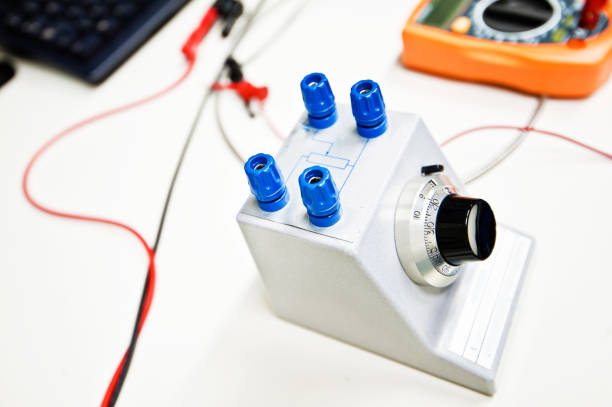
Achieving precise control in electronic circuits starts with understanding how a potentiometer responds to adjustment. The key lies in its “taper,” which defines how resistance changes as you rotate the knob. If you select the wrong taper, the device may feel inconsistent, overly sensitive, or difficult to fine-tune. Therefore, modern precision components—such as the widely used 3590S series—are engineered around specific mathematical curves to ensure accuracy and stability. In the following sections, we explore how linear and logarithmic tapers function and how to choose the right option for your application.
1. Linear Taper (Type B): The Foundation of Precision
Linear tapers provide a direct and proportional relationship between rotation and resistance, making them the preferred choice for technical accuracy.
How Linear Resistance Works
In a linear potentiometer, the resistance changes at a constant rate throughout the rotation. Consequently, if you turn the knob 50%, you get exactly 50% of the total resistance. Furthermore, this predictable behavior is ideal for mathematical calculations in a circuit. This makes it the standard choice for voltage dividers and bias adjustments. Therefore, most industrial sensors and tuning tools rely on this high-precision characteristic.
The Role of the 3590S
The 3590S model is a famous example of a high-precision linear potentiometer. Consequently, it features a multi-turn design for extremely fine adjustments. Furthermore, engineers use it in laboratory equipment where exact values are mandatory. It provides a stable and repeatable output for professional calibration tasks. Therefore, it represents the pinnacle of linear control in modern electronics.
2. Logarithmic Taper (Type A): The Audio Specialist
Logarithmic tapers, also known as audio tapers, follow a curved mathematical path.
Simulating Human Senses
The human ear does not linearly perceive sound intensity. Consequently, we are much more sensitive to changes at low volume levels. A logarithmic taper increases resistance slowly at first and then accelerates quickly. Furthermore, this curve mimics the way our ears hear changes in decibels. Therefore, this taper provides a “smooth” feel when adjusting the volume of a speaker.
3. Strategic Application Comparison
| Feature | Linear Taper (B) | Logarithmic Taper (A) |
| Resistance Change | Constant / Proportional | Exponential / Curved |
| Best Application | Voltage Dividers / Lab Tools | Volume Control / Audio Mixers |
| User Experience | Technical & Mathematical | Natural & Intuitive |
| Common Models | 3590S, 3296 Series | Standard Audio Knobs |
Consequently, the “best” taper depends entirely on the intended user interface. If you need to set a specific voltage, choose a linear model. Furthermore, if you are designing a guitar or a radio, select a logarithmic type. Therefore, matching the taper to the application ensures a professional and high-quality user experience.
4. Tips for Selecting the Right Component
-
Check the Marking: Look for “A” for Logarithmic or “B” for Linear on the casing.
-
Measure with a Meter: Turn the knob halfway and check the resistance percentage.
-
Consider the Turns: Multi-turn pots like the 3590S offer the best linear resolution.
Consequently, you will avoid common mistakes during the prototyping phase. High-quality precision potentiometers ensure your device remains stable over thousands of cycles. Furthermore, they prevent “dead spots” or sudden jumps in your signal. Therefore, investing in the correct taper improves both the reliability and the feel of your product.
Conclusion: Precision Engineering for Better Control
Precision control begins with the right design choice, and selecting between linear and logarithmic tapers plays a critical role in overall circuit performance. Instead of tolerating inconsistent or imprecise adjustments that compromise user experience, you can take a more accurate and reliable approach.
By adopting professional-grade potentiometer tapers, you ensure that every adjustment responds exactly as intended. As a result, your circuit behavior aligns closely with your original design calculations, delivering predictable and stable performance. Moreover, high-quality components provide smoother transitions and finer control, which significantly enhances usability in demanding applications.
In particular, integrating a high-precision 3590S linear potentiometer allows you to achieve exceptional accuracy and consistency. Consequently, your project benefits from refined control, improved responsiveness, and a more professional result. After all, precision engineering deserves components that deliver both smooth operation and exact performance.


